

This guide helps you choose and set up trading card game accessories for a playable deck and the cards you want to protect. It is for beginners who need to compare sleeves, deck boxes, binders, and play accessories without buying items that do not fit. Allow 30-60 minutes to check your cards, confirm sizes, test storage, and organize your setup.

Play games on Amazon Luna for your game nights, included with Prime
- A rotating selection of games, no download needed
- Play on TV, laptop or phone
- Fast, free delivery for your gear, too

Gomyrod 4-Row 3200+ Trading Card Storage with Commander Display
- ✔ Capacity: Over 3,200 unsleeved cards or up to 1,500 double-sleeved cards
- ✔ Layout: Four rows; eight compartments listed
- ✔ Included organization: 30 dividers

50 pcs Card Dividers Plastic Tabs Compatible with TCG – Multicolor
- ✔ Quantity: 50 dividers
- ✔ Material: Frosted polypropylene plastic
- ✔ Dimensions: 2.7 x 3.8 inches (6.9 x 9.7 cm)
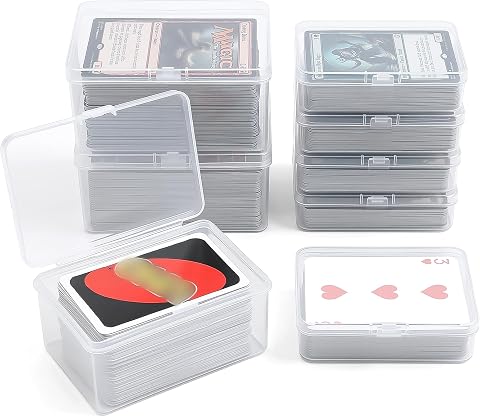
neotidy 6-Pack Clear Plastic Playing Card Storage Box with Snap Lids – Mixed Sizes for UN*, Standard Decks & Trading Cards
- ✔ Quantity: Six cases: two large and four compact
- ✔ Material: Rigid recycled plastic
- ✔ Color: Clear
Difficulty: Beginner | Time: 30-60 minutes
What You’ll Need
Tools & Materials:
- A few cards from the game you play
- Your deck list or an approximate card count
- Ruler or card-size specifications from the game publisher
- Budget for the accessories you need
- A clean, dry table
Knowledge:
- Basic familiarity with the game you play
- Ability to count deck cards and identify cards for storage
Check the game’s rules or event policy before choosing sleeves. Some tournaments require opaque sleeves or matching backs. Card dimensions and deck sizes differ among games, so verify the exact format instead of relying on a product label such as “standard.” Keep food and drinks away from cards while sorting.
Gomyrod 4-Row 3200+ Trading Card Storage with Commander Display
For a collection that has outgrown a small deck box, the Gomyrod four-row case is the most complete storage system in this group. Its stated capacity is over 3,200 unsleeved cards or up to 1,500 double-sleeved cards, with 30 dividers to help split cards into sections. That makes it better suited to managing a growing collection in one place than either the Suilung tabs, which only divide cards within a separate container, or the neotidy cases, which are intended for smaller batches.The water-resistant PU exterior, microfiber lining, and magnetic closure give this box a more protective, presentation-oriented feel than simple plastic cases. Its four acrylic display slots and included card supporters are especially useful when we want to show commander cards or selected favorites while keeping the rest stored. A handle also makes the box more portable than its substantial capacity might suggest, although the 12.6-inch footprint and three-pound weight still make it a larger travel choice than the neotidy set.The main limitation is card format, not organization: it does not accommodate top loaders or magnetic card holders. Buyers who store many individually protected hits should look elsewhere or keep those cards in a separate solution. It is also more box than a player needs for only a few decks. We rank it first because it handles bulk storage, sorting, and display together, but it is not the most flexible choice for oversized protection.
Pros:
- High stated capacity, including a separate figure for double-sleeved cards.
- Thirty dividers and four rows support more structured collection sorting.
- Microfiber interior and water-resistant PU exterior add protective layers.
- Acrylic display slots, card supporters, and a handle combine display with transport.
Cons:
- Does not accommodate top loaders or magnetic card holders.
- Its relatively large footprint and three-pound weight are less convenient for light travel.
- Display-focused extras may be unnecessary for buyers who only need basic bulk storage.
Best for: Collectors with a large standard-card collection who want multiple sections, display slots, and a carry handle in one storage box.
Not ideal for: Collectors whose storage system relies on top loaders or magnetic holders, or players who only need to carry one or two decks.
Bottom line: We recommend the Gomyrod as the strongest all-in-one choice for organizing and displaying a large standard-card collection, provided top loaders are not part of the plan.
“We recommend the Gomyrod as the strongest all-in-one choice for organizing and displaying a large standard-card collection, provided top loaders are not part of the plan.”
50 pcs Card Dividers Plastic Tabs Compatible with TCG – Multicolor
The Suilung set is a straightforward add-on for players who already have a storage box or binder but need clearer sections. With 50 lightweight polypropylene dividers, it gives us more sorting tabs than the Gomyrod’s included 30, and its compact 2.7 x 3.8-inch format is easy to keep with a portable collection. Multicolor tabs can help distinguish decks, sets, or card types at a glance, especially when the same storage box holds several categories.Unlike the Gomyrod, these are not a self-contained storage solution: there is no outer case, protective closure, or display feature. Compared with the neotidy cases, the dividers take up little space and can organize cards inside a larger system, but they do not individually enclose or protect a deck. Their value depends on having compatible standard-size card storage already in place.We should also account for the manual setup. The tabs have no pre-printed classifications, so we need to write our own labels, and the stated fit is for standard-size cards rather than larger items. That flexibility is helpful if our categories change, but less convenient for anyone hoping to open a ready-labeled sorting kit. This pick ranks behind the Gomyrod because it solves a narrower problem, yet it is the most sensible choice when organization—not another box—is what the collection lacks.
Pros:
- Fifty dividers offer many sections for sorting by deck, set, or card type.
- Frosted polypropylene is described as durable and fade-resistant.
- Compact, lightweight design is convenient to carry with a binder or box.
- Multicolor tabs make categories easier to distinguish visually.
Cons:
- No pre-printed labels are included, so classifications must be written by hand.
- Designed for standard-size cards and may not suit larger items.
- Does not provide a case or independent protection for cards.
Best for: Players and collectors with an existing standard-card box or binder who want lightweight, customizable sections for sorting.
Not ideal for: Buyers who need a protective case, pre-printed labels, or dividers for oversized cards and accessories.
Bottom line: We would choose these dividers when an existing storage setup needs more flexible sorting, not when we need a new way to protect or transport decks.
“We would choose these dividers when an existing storage setup needs more flexible sorting, not when we need a new way to protect or transport decks.”
neotidy 6-Pack Clear Plastic Playing Card Storage Box with Snap Lids – Mixed Sizes for UN*, Standard Decks & Trading Cards
The neotidy set is built around a different need from the Gomyrod: keeping several smaller groups of cards in separate, visible cases rather than consolidating a collection. It includes six clear plastic boxes in mixed sizes, with two large cases and four compact ones. That makes it a practical fit for players carrying different decks, tokens, or small accessories, while transparent walls let us identify contents without opening every lid.For travel and shelf organization, the stackable shape and snap closures are more convenient than loose cards or a single open storage container. The cases are also more self-contained than Suilung’s dividers, which require another box or binder to do their job. On the other hand, the neotidy set offers no comparable internal labeling system, large collection capacity, or display accessories. It is best understood as a set of compact deck containers, not a replacement for the Gomyrod’s bulk storage.The set’s mixed sizing broadens its use across standard decks and some small items, but the listing does not provide a card-count capacity for each case, so we should check dimensions against our sleeves and deck configuration. Snap lids can also feel stiff to open, a drawback when we expect to access a case repeatedly during play. With only six containers, this option suits a handful of decks better than a large or continuously expanding collection. We rank it third overall because its convenience is real but its role is narrower than bulk storage or expandable sorting.
Pros:
- Six cases in two sizes can separate different decks and small accessories.
- Clear plastic makes contents easy to identify without opening the boxes.
- Snap lids and stackable shapes support tidy storage and transport.
- Lightweight construction is convenient for carrying a small group of decks.
Cons:
- Six cases may not be enough for a large or fast-growing collection.
- Snap lids may require extra force to open.
- Exact card-count capacity for each case is not specified.
Best for: Players who want to separate and carry a small rotation of decks, standard playing cards, or compact accessories in visible cases.
Not ideal for: Collectors seeking bulk capacity, many customizable sorting sections, or cases confirmed to fit top loaders and thickly protected cards.
Bottom line: We’d pick the neotidy set for compact, clearly visible deck separation, while choosing the Gomyrod for collection-scale storage and Suilung for sorting within a system we already own.
“We’d pick the neotidy set for compact, clearly visible deck separation, while choosing the Gomyrod for collection-scale storage and Suilung for sorting within a system we already own.”
As an Amazon Associate we earn from qualifying purchases.
Before You Start
Decide what problem you need to solve first: protect cards during play, store a collection, transport a deck, or improve play comfort. You do not need every accessory at once. Start with the deck and cards you use most, then add storage or table accessories as needed. Set aside one unsleeved card for checking fit, and handle cards by their edges with clean, dry hands.
Step-by-Step Instructions
Step 1: List your accessory needs
Write down the cards and activities you need to support. Count the cards in the deck, note whether you use tokens or sideboard cards, and mark any valuable or frequently played cards. Separate your needs into protection, transport, collection storage, and table play. This prevents buying accessories that solve a different problem.
Tip: Prioritize sleeves for cards played often, then choose a deck box that can hold the sleeved deck and any required extras.
Check: You have a short list of specific needs and a card count for each group.
Step 2: Confirm card and sleeve sizes
Check the game’s official card dimensions or measure a card with a ruler. Compare that measurement with the sleeve manufacturer’s stated inner dimensions or compatible game list. Decide whether you want clear or opaque sleeve backs, and check whether tournament rules require matching sleeves. If you plan to double-sleeve, confirm that both sleeve layers are made for your card size.
Tip: Product terms such as “standard size” can mean different things across brands. Use measurements and game-specific compatibility information rather than the label alone.
Check: You have identified a sleeve size and style that match your cards and any rules you need to follow.
Step 3: Choose sleeves and test one card
Buy sleeves from a reputable seller in a quantity large enough for the deck, plus a few spares. Open one sleeve and slide in a card gently without bending it or forcing the corners. Check that the card sits flat, does not move excessively, and is fully covered by the sleeve. If using an inner sleeve, fit it first and follow the maker’s directions for placing it inside the outer sleeve.
Tip: Do not use a sleeve that catches a corner or leaves the card exposed. Stop if the card resists; forcing it can damage the card.
Check: The test card enters smoothly, lies flat, and has no exposed edge or loose, distracting fit.
Step 4: Sleeve the cards you play
Work on a clean, dry surface. Sleeve cards one at a time, checking that each card faces the same direction and sits fully inside its sleeve. Keep the deck order intact if it is already arranged, and count the finished deck against your list. Replace sleeves that split, wrinkle, or differ noticeably from the rest of the deck.
Tip: Avoid pressing down hard on a sleeved stack. Trapped air can make the deck bulky; let it settle naturally or follow the sleeve maker’s guidance.
Check: Every intended deck card is protected, the count is correct, and the sleeves look consistent.
Step 5: Select and test a deck box
Choose a box sized for the deck in its sleeves, not for unsleeved cards. Check the stated capacity for sleeved cards and whether it includes room for tokens, a sideboard, or a divider. Place the sleeved deck in the box and close it without pressing or bending the cards. Tip the closed box gently to check that cards stay contained.
Tip: Capacity claims vary by sleeve thickness and box shape. Test the actual combination before taking it to a game or buying several boxes.
Check: The box closes securely, the cards fit without pressure, and the deck does not spill when the box is handled normally.
Step 6: Choose storage for the rest of your collection
Sort collection cards by game, set, deck, or another system you can maintain. Use binders for cards you want to browse and boxes for larger groups stored in order. Check that binder pages are designed for trading cards and that cards fit without being forced into pockets. Store cards upright or flat as the storage product directs, away from heat, dampness, and direct sunlight.
Tip: Do not overfill binder pockets or storage boxes. Pressure can bend cards, and tight pockets make removal risky.
Check: Cards are grouped in a system you can find again, sit securely in their pages or dividers, and are not bent or crowded.
Step 7: Add only the play accessories your setup needs
Check your game and local play space to decide whether a playmat, counters, dice, token holder, or deck divider will help. Confirm that counters or dice are suitable for tracking the values your game uses. If you buy a playmat, choose a size that fits the table and your usual play area. Pack small items in a pouch or compartment so they do not rub against unprotected cards.
Tip: A playmat is optional. Prioritize accessories that meet a game requirement or solve a repeated problem at your table.
Check: Your chosen items are compatible with your game, easy to access, and do not crowd or damage the deck.
Step 8: Pack and inspect your complete setup
Place the deck in its box, add tokens and other loose accessories to separate compartments, and check that the lid or zipper closes fully. Before play, confirm the deck count, sleeve condition, and tournament compliance. After play, return cards to the same storage system and remove any damaged sleeves for replacement.
Tip: Keep a few matching spare sleeves with your supplies, especially if you play at events.
Check: You can transport the deck without loose items pressing on cards, and the setup is ready for a game under the rules you expect to play.
Common Mistakes to Avoid
- Buying sleeves based only on a vague size label. — Check card measurements and the sleeve maker’s compatibility details, then test one sleeve before sleeving the deck.
- Choosing a deck box based on unsleeved capacity. — Use the box’s sleeved-card capacity and test it with your actual sleeves, tokens, and deck.
- Overfilling a binder or storage box. — Leave enough room to remove cards without bending them, and use additional pages or boxes when storage feels tight.
- Using sleeves that violate event rules or vary across the deck. — Check the event policy before buying and use matching, undamaged sleeves throughout the deck when required.
Troubleshooting
Problem: A card will not slide into a sleeve smoothly.
Solution: Stop rather than pushing. Confirm the sleeve size and orientation, and inspect for a damaged or sealed sleeve. Try a correctly sized replacement on a different card.
Problem: The sleeved deck does not fit the deck box.
Solution: Remove extras and check whether the box capacity is for single-sleeved or unsleeved cards. If it still presses on cards, use a larger box rather than forcing the lid closed.
Problem: The deck feels bulky or cards stick together after sleeving.
Solution: Check that sleeves are the right size and free from damage or debris. Let the stack settle, and review the sleeve maker’s instructions if you double-sleeved. Replace sleeves that remain tacky or distorted.
Problem: Binder cards are difficult to remove or appear curved.
Solution: Take cards out carefully by the edges, reduce the number of cards per page or binder, and move them to a roomier product. Do not pull a card out by one corner.
What Success Looks Like
Your finished setup has sleeves that fit without exposing or bending cards, a deck box that closes without pressure, and collection storage that does not crowd cards. Loose counters and tokens are contained separately. The deck count is correct, sleeves meet the rules for your intended play, and you can locate stored cards using your chosen sorting system.
Next Steps
After each game, check for torn sleeves, bent cards, and missing tokens. Replace damaged sleeves with matching ones, and update your deck box or storage labels when your collection changes. Keep cards in a dry, stable place away from direct sun, heat, and food or drinks. If you plan to attend an event, check its current accessory and sleeve rules before packing.
Frequently Asked Questions
Do I need to sleeve every card?
Start with cards you play regularly, valuable cards, and cards that need to look consistent during play. Sleeving an entire deck is often practical because it gives cards a uniform feel and protects them from handling. Follow any event rules for the deck you plan to use.
Should I use clear or opaque sleeves?
Clear sleeves show the card back and may suit casual storage or play when allowed. Opaque sleeves hide the back and can reduce concerns about marked or uneven card backs. Check the game and event policy, since requirements vary.
Are double sleeves necessary?
No. Double-sleeving adds another layer of protection but also increases deck thickness and cost. If you choose it, use compatible inner and outer sleeves and confirm the deck still fits its box and complies with event rules.
What should I buy first?
If you play with the cards, start with correctly sized sleeves and a box that fits the sleeved deck. Add a binder or storage box if you need to organize a collection, then purchase optional table accessories based on your game and play space.
How can I tell when a sleeve needs replacing?
Replace a sleeve if it splits, has a sharp crease, is heavily scratched, or differs enough from the others to make the card identifiable by touch or appearance. Use a matching spare when possible, especially for event play.
Fall Picks
fall essentials
As an affiliate, we earn on qualifying purchases.