
Choosing trading card game accessories often comes down to a practical question: should you spend first on sleeves for cards you play with, or a binder for cards you want to store and browse? Sleeves fit around individual cards and stay on during handling, shuffling, and play. Binders hold cards in pockets, making a collection easier to sort, view, and transport. Neither replaces the other completely, and the better first purchase depends on whether your priority is protecting a deck in use or organizing cards outside a game.

Play games on Amazon Luna for your game nights, included with Prime
- A rotating selection of games, no download needed
- Play on TV, laptop or phone
- Fast, free delivery for your gear, too

Gomyrod 4-Row 3200+ Trading Card Storage with Commander Display
- ✔ Capacity: Over 3,200 unsleeved cards; up to 1,500 double-sleeved cards
- ✔ Layout: Four rows
- ✔ Dimensions: 12.6 x 12.6 x 3.9 inches
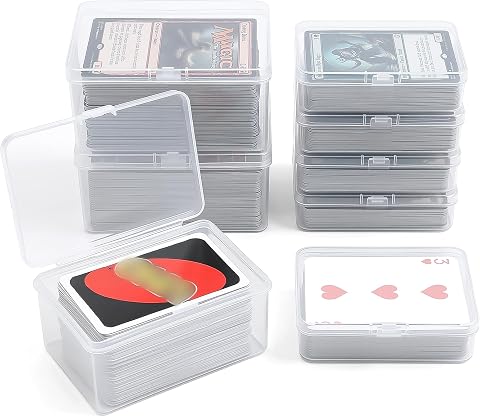
neotidy 6-Pack Clear Plastic Playing Card Storage Box with Snap Lids – Mixed Sizes for UN*, Standard Decks & Trading Cards
- ✔ Number of cases: Six
- ✔ Case sizes: Two large and four compact
- ✔ Material: Rigid recycled plastic

50 pcs Card Dividers Plastic Tabs Compatible with TCG – Multicolor
- ✔ Quantity: 50 dividers
- ✔ Material: Polypropylene plastic
- ✔ Dimensions: 2.7 x 3.8 inches (6.9 x 9.7 cm)
This comparison treats sleeves and binders as competing first investments, not interchangeable products. Sleeves are the stronger choice for playable cards and frequent handling; binders are better for collections, trades, and visual organization. If you play regularly, buy sleeves first. If your cards mostly stay out of decks, a well-made binder may provide more useful day-to-day access. Many collectors eventually want both, but there is no need to buy both at once.
At a Glance
| Criteria | Trading card sleeves | Trading card binders | Winner |
|---|---|---|---|
| Protection during play | Protects individual cards from routine handling, surface wear, and some spills; cards remain ready for play. | Keeps cards in pockets for storage, but cards must be removed for play and are not protected from every handling risk. | A |
| Collection organization | Offers little collection-wide sorting; cards must be organized separately in boxes or other storage. | Makes it easier to group, sort, and display cards in a structured format. | B |
| Access and browsing | Cards can be handled and shuffled, but sleeves do not create an at-a-glance collection display. | Excellent for viewing and comparing stored cards; less convenient than sleeves for active shuffling or play. | B |
| Portability | A sleeved deck is compact and game-ready; carrying many sleeved cards can still require a deck box. | Convenient for carrying selected pages or a collection, but larger binders add bulk and need careful handling. | Depends |
| Capacity and flexibility | One sleeve per card; suitable for decks and selected cards, but not an efficient way to store a large collection. | Stores many cards in one place, with capacity limited by page design and binder construction. | B |
| Cost and value | Usually a lower-cost first step for cards played often; quality and fit affect protection and handling. | Costs more than a small sleeve purchase in many cases, but can offer better value when organization and browsing are the main goals. | Depends |
Gomyrod 4-Row 3200+ Trading Card Storage with Commander Display
For players whose cards have outgrown a handful of deck cases, Gomyrod’s four-row format is the most complete storage system in this comparison. Its stated capacity is over 3,200 unsleeved cards, or up to 1,500 double-sleeved cards, giving it a clear advantage over the six individual neotidy cases for bulk collection storage. The capacity difference matters, but so does the built-in sorting: 30 dividers help separate sections without requiring an additional purchase like Suilung’s loose divider set.The box also suits collectors who want some cards visible rather than hidden away. Four acrylic display slots and eight card supporters let users arrange featured cards alongside stored stock, while the front window pocket offers another place for identification or display. Its water-resistant PU exterior, microfiber interior, and magnetic closure make it a more substantial home for a collection than lightweight snap cases. At three pounds before cards are added, however, it is not the easiest option for someone who wants to travel light. The handle helps with transport, but the box’s 12.6-inch square footprint still takes meaningful space.We would choose this over neotidy when the goal is consolidating many cards in one organized container, and over Suilung when dividers alone are not enough. The key limitation is card format: the product does not accommodate top loaders or magnetic card holders. Buyers storing prized cards in rigid holders should plan a separate solution rather than assuming the large capacity covers every card setup. It is also less suitable for someone who only needs a small travel case for a couple of decks.
Pros:
- Four-row storage holds over 3,200 unsleeved cards or up to 1,500 double-sleeved cards.
- Includes 30 dividers, four acrylic display holders, and eight card supporters.
- Water-resistant PU exterior and soft microfiber interior provide a more protective enclosure than loose dividers.
- Magnetic closure, front window pocket, and carrying handle support organized transport and display.
Cons:
- Does not accommodate top loaders or magnetic card holders.
- Its roughly 12.6-inch square body and three-pound weight make it bulkier than the neotidy cases or Suilung dividers.
- Capacity drops substantially when cards are double-sleeved.
Best for: Collectors and regular players who need a single, high-capacity home for standard cards, including sleeved cards, and want built-in sorting and display features.
Not ideal for: Buyers who store cards in top loaders or magnetic holders, or anyone looking for a compact case for just a few decks.
Bottom line: We rank Gomyrod first for its combination of substantial card capacity, built-in sorting, and display utility, provided your collection does not depend on rigid holders.
“We rank Gomyrod first for its combination of substantial card capacity, built-in sorting, and display utility, provided your collection does not depend on rigid holders.”
neotidy 6-Pack Clear Plastic Playing Card Storage Box with Snap Lids – Mixed Sizes for UN*, Standard Decks & Trading Cards
The neotidy set takes the opposite approach to Gomyrod: rather than gathering a collection in one large box, it divides storage among six individual clear cases. Two larger and four compact cases give players more flexibility for keeping decks, card types, or small accessories separate. That makes the set a better fit for travel and changing game nights than the Gomyrod box, especially when carrying several distinct decks is more useful than transporting thousands of cards at once.Transparent plastic means the contents can be identified without opening every case, and the stackable shape helps make a group of cases easier to store together. The snap lids are intended to keep out dust and help protect cards during routine storage or transit. Compared with Suilung’s dividers, neotidy provides actual enclosures; compared with Gomyrod, it offers more separation between small groups but much less total capacity. Mixed sizes broaden its usefulness across standard decks, trading cards, and small accessories, though the supplied details do not specify sleeve-based capacities. We would avoid assuming that every sleeved deck will fit without checking the available interior dimensions.The set’s tradeoffs follow from its compact format. Six cases may not stretch far for a large collection, and separate lids mean repeated opening and closing rather than accessing several rows at once. The lids can also feel stiff and may require extra force, which is worth considering for younger players or anyone who opens cases frequently. Choose it when flexibility and visible contents matter more than maximum capacity; choose Gomyrod for bulk storage, or Suilung when the cards already have a suitable home and only need clearer organization.
Pros:
- Six cases across two sizes let users separate multiple decks and small accessories.
- Clear bodies make contents easy to identify without opening the cases.
- Snap lids help shield stored cards from dust during storage and travel.
- Stackable, lightweight form is easier to distribute in a bag than the Gomyrod box.
Cons:
- Six cases may be insufficient for a large or fast-growing collection.
- Snap lids can be stiff and may take extra force to open.
- Sleeved-card capacity and compatibility with rigid holders are not specified.
Best for: Players who carry or store several separate decks and want clear, stackable cases in more than one size.
Not ideal for: Collectors seeking one high-capacity storage system, or buyers who need a clearly specified fit for top loaders, magnetic holders, or particular sleeved-card configurations.
Bottom line: We recommend neotidy for players who value separate, visible, portable deck storage more than the large-scale capacity of Gomyrod.
“We recommend neotidy for players who value separate, visible, portable deck storage more than the large-scale capacity of Gomyrod.”
50 pcs Card Dividers Plastic Tabs Compatible with TCG – Multicolor
Suilung’s dividers address an organizational problem rather than a storage one. The pack provides 50 compact polypropylene tabs for marking sections in a box, binder, or other suitable setup. If a collection is already stored safely but takes too long to browse, colored dividers can create quick visual groupings for sets, formats, decks, or other categories. That makes this the most focused and lightweight pick in our lineup—and a natural add-on to a large box such as Gomyrod, which includes its own 30 dividers but may still leave collectors wanting more sorting markers.At 2.7 x 3.8 inches, these dividers are designed around standard-size cards and are small enough to carry in a wallet, backpack, or binder. Their multicolor assortment can make categories easier to scan, while the polypropylene construction is described as durable and fade-resistant. Unlike the neotidy cases, however, they do not enclose cards or protect them from dust and handling. They also do not supply printed labels: buyers need to write their own classifications, so the system works best for people willing to set up and maintain their own taxonomy.We place Suilung third not because it is a poor organizer, but because its role is narrower than the other two products. It cannot replace a case for travel or a box for bulk storage. Compared with neotidy, it offers more sorting pieces but no containment; compared with Gomyrod, it is portable and inexpensive in form but lacks an integrated storage structure. Buyers with larger cards or accessories should also note the stated standard-card focus. Choose these when the missing piece is clearer sorting inside existing storage, not when the collection needs a new protective home.
Pros:
- Fifty dividers provide many sorting points for an existing storage setup.
- Compact 2.7 x 3.8-inch size is designed for standard-size cards and easy to carry.
- Multicolor tabs support quick visual grouping.
- Polypropylene construction is described as durable and fade-resistant.
Cons:
- Does not contain, cover, or independently protect cards.
- No pre-printed labels, so classifications must be written manually.
- Designed for standard-size cards and may not suit larger items.
Best for: Collectors with an existing box, binder, or storage system who want many lightweight, color-coded sections for standard-size cards.
Not ideal for: Players looking for a protective case, a ready-labeled filing system, or dividers sized for larger cards and items.
Bottom line: We choose Suilung when a collection already has a home and needs affordable, portable sorting rather than another storage container.
“We choose Suilung when a collection already has a home and needs affordable, portable sorting rather than another storage container.”
As an Amazon Associate we earn from qualifying purchases.
Key Differences
The key distinction is what each accessory does while a card is being used. A sleeve stays on the card, so it can reduce everyday wear from shuffling, handling, and placing cards on a table. A binder is a storage and display system: it keeps cards arranged in pockets, but a card must come out before it can be played. That makes sleeves the clear first purchase for a deck that sees regular games, while binders make more sense for cards kept for collecting, trading, or reference.
The tradeoff continues with access and scale. Sleeves are compact for a playable deck, but they do not sort or display a collection. A binder makes browsing and grouping cards easier, yet takes up more space and needs careful transport. They are complementary accessories rather than direct substitutes: sleeves protect cards in use; binders make stored cards easier to manage. Buy for your current use instead of assuming every card needs the same setup.
Detailed Comparison
Protection during play (Trading card sleeves wins — major)
Sleeves win by a major margin. A correctly sized sleeve stays on a card during shuffling and play, helping limit routine surface wear and direct contact with hands and tables. A binder can protect cards while they remain stored in its pockets, but it does not accompany a card into a game. For a deck that is handled frequently, sleeves address the risk at the point it occurs. They are not a guarantee against spills, bending, or damage, so careful handling still matters.
Collection organization (Trading card binders wins — major)
Binders win by a major margin. Pocket pages give cards defined places, which helps group a collection by game, set, character, or trade status. Sleeves provide individual protection but no system for finding a particular card among a large collection. If the main frustration is loose cards spread across boxes or stacks, a binder can make the collection easier to manage. It is less useful for cards that are constantly moving between decks.
Access and browsing (Trading card binders wins — moderate)
Binders win by a moderate margin. Turning pages lets a collector review cards without sorting through a pile, and the visible layout makes comparisons and trade discussions easier. Sleeved cards are accessible one at a time and better suited to deck building or play, but they do not offer the same overview. Choose based on whether you want to see a group of stored cards at once or handle individual cards in a game.
Portability (moderate difference)
This is a use-dependent tie. Sleeves add little bulk to a single deck, especially when paired with a deck box, so they are convenient for regular play. A binder travels well when you need to show or trade a selected collection, but a full one is bulkier and needs more care than a compact deck. Choose sleeves for carrying a playable deck; choose a binder for taking organized pages to a trade or event. Neither is ideal for carrying every card without a separate plan.
Capacity and flexibility (Trading card binders wins — moderate)
Binders win for storing many cards, by a moderate margin. A binder can hold a substantial selection in a compact, browsable format, although its real capacity depends on its pages and construction. Sleeves are applied card by card and work well for a deck or a chosen group, not as a complete collection filing method. For a large collection, sleeves alone leave the organization problem unsolved; a binder or other storage system is more practical.
Cost and value (moderate difference)
There is no universal winner; the better value follows the job. Sleeves are often the cheaper first purchase when you only need to protect a deck, and spending on them pays off most for cards played or handled often. A binder can cost more than a small pack of sleeves, but it earns its place when it replaces disorder with usable storage and display. Paying for a binder is not worthwhile if you rarely browse or trade your cards; paying for sleeves across a large collection may also be wasteful if most cards remain stored.
Trading card sleeves: Pros and Cons
Pros:
- Stay on cards during shuffling and play, helping limit routine wear.
- A sensible first purchase for frequently used decks.
- Compact and game-ready when paired with a suitable deck box.
- Can be applied selectively to the cards that get the most handling.
Cons:
- Do not organize or display a collection.
- Not an efficient standalone storage system for large numbers of cards.
- Sleeve fit and quality matter; unsuitable sleeves can handle poorly or provide less useful protection.
- Do not prevent all damage, including bending or damage from careless handling.
Trading card binders: Pros and Cons
Pros:
- Keeps selected cards organized and easy to browse.
- Useful for collection display, sorting, and trade discussions.
- Can store many cards in one place, depending on page and binder capacity.
- Makes it easier to review a group without handling every card individually.
Cons:
- Cards must be removed from pockets before play.
- Bulkier than carrying a single deck and can be awkward when full.
- Pockets and pages are not a substitute for sleeves on cards that are regularly played.
- Offers less value if the owner does not need organized browsing or display.
Who Should Choose What
Choose Trading card sleeves if:
- You regularly shuffle and play with a deck and want to limit everyday handling wear.
- You need a low-bulk, game-ready first accessory rather than a way to file a collection.
- You want to protect only the cards you use often instead of investing in collection-wide storage.
Choose Trading card binders if:
- Your priority is sorting, displaying, or browsing cards that mostly stay out of decks.
- You bring cards to trades or events and want to show an organized selection.
- Loose cards are difficult to find, and a single browsable storage format would help.
Skip both if: If your immediate need is simply secure transport for a deck, a deck box may be the more direct purchase; sleeves and binders serve protection and organization roles, not rigid deck containment.
Value for Money
Paying more for a binder is worth it when you will regularly use its organization, browsing, or trade-display features. Its value comes from making stored cards easier to find and handle as a collection, not from improving how a deck plays. If you only need to protect one active deck, sleeves are usually the more economical first purchase. A binder is poor value when it will sit unused, just as buying sleeves for every card can be unnecessary when most of the collection stays stored.
For many players, the sensible order is to sleeve the deck they use, then add a binder when a collection becomes difficult to sort or they want to display it. Collectors who rarely play can reverse that order. Neither choice needs to be an all-or-nothing commitment: protect frequently handled cards and organize the cards that benefit from browsing.
Final Verdict
Choose sleeves first if you play regularly. They address the biggest practical risk for active cards by staying on during handling and games. Choose a binder first if your cards are primarily a collection you want to sort, view, or take to trades. The deciding factor is whether your cards are mostly in use or mostly in storage. For most active players, sleeves deliver the more immediate benefit; for collectors who rarely play, a binder is the better first buy. Neither replaces the other when you need both play protection and collection organization.
Frequently Asked Questions
Do I need both sleeves and a binder?
Not necessarily. Buy sleeves if your first need is protecting cards during play; buy a binder if you need organized storage and browsing. They work well together when you play with some cards and collect others, but there is no need to buy both before you know which problem matters most.
Are binder pockets enough protection for valuable cards?
A binder pocket can help keep a card stored and reduce routine handling, but it does not provide the same use-case protection as a sleeve that stays on the card during play. For a valuable card you handle often, a suitable sleeve is a practical added layer. Store and handle binders carefully as well; pockets cannot prevent every kind of damage.
Should I sleeve cards before putting them in a binder?
It depends on the fit and your storage preference. Sleeves add a layer around each card, but a sleeved card must fit comfortably in the binder pocket without forcing it. Check the pocket dimensions and sleeve fit rather than assuming every combination will work. For cards you play with, use sleeves regardless of whether you also store them in a binder.
Which should a new player buy first?
A new player who plans to use a deck should generally start with sleeves, since they protect cards during the activity that causes frequent handling. A binder is the better first purchase for someone collecting cards without playing much. If the main concern is keeping a deck together while traveling, a deck box may be a more direct addition.
Fall Picks
fall essentials
As an affiliate, we earn on qualifying purchases.