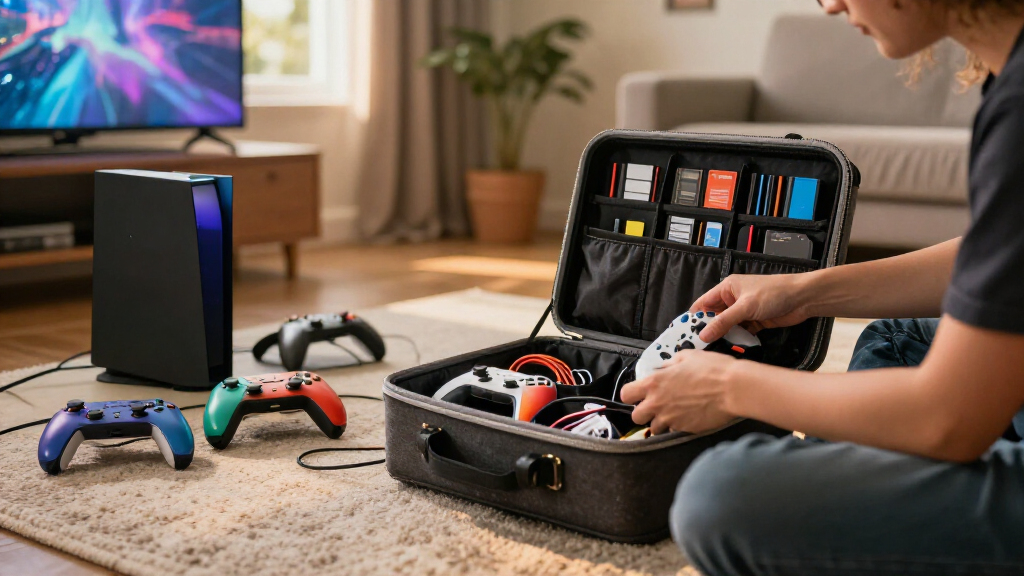
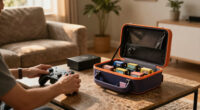
Choosing between a protective gaming storage case and a gaming organizer case comes down to what happens after you pack your gear. A protective case is built to carry a console or handheld system with less risk from bumps, pressure, and travel. An organizer case is built to keep games, controllers, cables, and small accessories sorted and easy to reach, often with more flexibility in how you arrange them.

Play games on Amazon Luna for your game nights, included with Prime
- A rotating selection of games, no download needed
- Play on TV, laptop or phone
- Fast, free delivery for your gear, too

Nargos Video Game Storage Tower for PS5, PS4, PS3, Xbox and Blu-ray Cases, Black
- ✔ Capacity: Up to 36 cases
- ✔ Compatible cases: PS5, PS4, PS3, Xbox Series X/S, Xbox One, standard Blu-ray
- ✔ Incompatible cases: DVD, Xbox 360, PS2, slim cases

Tutata Magnetic Video Game and Blu-ray Storage Box, Holds up to 20 Cases
- ✔ Capacity: Up to 20 cases
- ✔ Internal dimensions: 12 × 6.7 × 5.3 in
- ✔ External dimensions: 12.4 × 6.9 × 5.5 in

Video Game Disc Rack Tower for PS5, PS4, Xbox, and Nintendo Switch
- ✔ Capacity: Up to 40 game discs
- ✔ Compatibility: PS5, PS4, Xbox One/Series, Nintendo Switch
- ✔ Incompatible formats: Xbox 360 cases, DVDs
That difference matters more than a long list of pockets. If your system regularly travels in a backpack, car, or carry-on, the extra structure and padding of Option A can justify its bulk. If your gear mostly stays at home, or you want one place for a growing collection of accessories, Option B may offer more useful capacity. The comparisons below focus on shared buying criteria, since product construction and included inserts vary by model.
At a Glance
| Criteria | Protective gaming storage cases | Gaming organizer cases | Winner |
|---|---|---|---|
| Impact protection | Usually more structured, with padded compartments or a firm shell | Ranges from light dividers to padded compartments; check construction | A |
| Portability | Made for carrying, though added protection can increase bulk | Often convenient to carry, but some models are designed mainly for shelves | Depends |
| Storage flexibility | Often shaped around a particular console or device | Typically offers adjustable dividers, trays, or varied compartments | B |
| Organization and access | Keeps the main device secure; accessory sorting varies by design | Strong at separating games, cables, controllers, and smaller items | B |
| Capacity for a full setup | Good for a device and selected essentials; larger setups may need another bag | Often fits a wider mix of accessories, depending on size | B |
| Home storage | Compact and ready to grab, but less adaptable to changing collections | Useful for keeping a collection together and reducing loose-item clutter | B |
| Value for typical use | Best value for frequent travel or equipment that needs extra protection | Best value when sorting and capacity matter more than firm impact protection | Depends |
Nargos Video Game Storage Tower for PS5, PS4, PS3, Xbox and Blu-ray Cases, Black
The Nargos tower makes the most sense when our main problem is a growing pile of compatible game cases and we want them gathered in one narrow organizer. It holds up to 36 cases and measures 30.4 inches tall, so it uses vertical space instead of spreading games across a shelf. We can also arrange it horizontally, which gives us another placement option if a tall tower does not suit the room. That flexibility helps it edge ahead of the disc rack for buyers whose priority is organizing cases in a dedicated tower.Its open, tool-free snap-together construction is straightforward in concept: cases remain accessible without opening a lid or box. The lightweight ABS plastic and non-slip base pads support a simple floor-standing setup, but this is not enclosed storage. We should account for where the tower will sit and whether cases need protection from dust or casual handling. Tutata is the stronger match if we want a closed container that can stack with other boxes.Compatibility is the important qualifier. Nargos lists support for PS5, PS4, PS3, Xbox Series X/S, Xbox One, and standard Blu-ray cases, while excluding DVD, Xbox 360, PS2, and slim cases. That restriction can make the 36-case capacity less useful for mixed-format collections. We should check every case type before choosing it; buyers with mostly listed formats get a versatile organizer, while anyone relying on excluded cases should look elsewhere.
Pros:
- Holds up to 36 compatible game or standard Blu-ray cases
- Can be positioned vertically or horizontally
- Tool-free snap-together assembly
- Lightweight ABS construction with non-slip base pads
Cons:
- Does not fit DVD, Xbox 360, PS2 or slim cases
- Open tower design leaves cases exposed
Best for: Players with a sizable collection of compatible PS5, PS4, PS3, Xbox Series X/S or Xbox One cases who want a narrow, reconfigurable floor organizer.
Not ideal for: Collectors whose library includes many DVD, Xbox 360, PS2 or slim cases, or anyone who needs enclosed, dust-shielding storage.
Bottom line: For a large collection in the listed formats, Nargos offers the most adaptable balance of capacity and compact floor storage.
“For a large collection in the listed formats, Nargos offers the most adaptable balance of capacity and compact floor storage.”
Tutata Magnetic Video Game and Blu-ray Storage Box, Holds up to 20 Cases
Tutata is the clearest alternative when we value a contained, orderly box more than the largest capacity. It holds up to 20 steelbook or Blu-ray cases, and its 5.3-inch height keeps titles visible for browsing. A magnetic closure makes repeated access easier than a container that needs a separate lid, while the stackable design can help us group several collections together. Compared with Nargos and the disc rack, this option feels better suited to shelves or cabinets where an open tower would look out of place.The tradeoff is that Tutata requires assembly and is made from rigid cardboard with a water-resistant laminate, rather than ABS plastic. The finish is described as water-resistant, not waterproof, so we should not treat it as a protective travel case or leave it where spills are likely. Assembly involves peeling a sticker, assembling, and gluing the box; buyers who want a ready-to-use organizer should factor that in. Once assembled, its rectangular shape offers a more enclosed approach than either rack.Fit also deserves attention. Tutata is designed for most cases, but the product recommends measuring items first; internal dimensions are 12 × 6.7 × 5.3 inches. That makes it less straightforward than Nargos’s explicit list of supported game formats. We would choose it for a carefully measured set of cases that benefits from a closure and stacking, and skip it when we need a tall rack, maximum capacity, or certainty for unusual case sizes.
Pros:
- Holds up to 20 cases
- Magnetic closure is convenient for repeated access
- Stackable design with water-resistant laminate
- Low profile keeps titles visible for browsing
Cons:
- Requires assembly, including gluing
- Fit varies, so measuring cases before use is recommended
- Cardboard construction is not a substitute for a hard protective case
Best for: Collectors who want to keep a measured set of up to 20 steelbook or Blu-ray cases together in a stackable, closed box with visible titles.
Not ideal for: Buyers seeking a high-capacity open rack, a rigid plastic tower, or storage for cases they have not checked against the internal dimensions.
Bottom line: Tutata is the lineup’s practical choice for measured collections that benefit from covered, stackable shelf storage.
“Tutata is the lineup’s practical choice for measured collections that benefit from covered, stackable shelf storage.”
Video Game Disc Rack Tower for PS5, PS4, Xbox, and Nintendo Switch
This disc rack has the lineup’s highest stated capacity, fitting up to 40 game discs in a compact tower measuring 15.75 inches high. Its smaller height and 4.72-inch depth can make it easier to place near a console than the taller Nargos unit, especially when we want frequently played games within reach. It can stand vertically or sit horizontally, and tool-free assembly makes it a relatively simple option to set up or take apart.The capacity claim needs to be read alongside the rack’s slot dimensions: each slot is 0.59 inches wide and 6.85 inches high. This is a rack for the listed game formats, not a universal media shelf. It supports PS5, PS4, Xbox One/Series, and Nintendo Switch, but the product explicitly excludes Xbox 360 cases and DVDs. Nargos also excludes several case types, but its stated 36-case capacity and taller form make it a better fit for buyers prioritizing a larger tower for the formats it supports.We would pick this model when a compact footprint and disc count are the main priorities, not when we need closed storage or broad format coverage. The stable base and flexible orientation make it useful as an accessible game rack, but its narrow slots impose a real fit constraint. Tutata avoids that open-slot format by using an enclosed box, though it holds fewer cases and calls for measuring, too. Buyers should compare their actual cases with the listed dimensions before filling the rack.
Pros:
- Holds up to 40 game discs
- Compact dimensions and vertical or horizontal placement
- Tool-free assembly and disassembly
- Stable base for tabletop or room placement
Cons:
- Not sized for Xbox 360 cases or DVDs
- 0.59-inch slot width limits case fit
- Open rack does not cover stored games
Best for: Players with compatible PS5, PS4, Xbox One/Series or Nintendo Switch games who want a compact rack with a high stated disc capacity.
Not ideal for: Collectors with Xbox 360 cases or DVDs, or anyone who wants enclosed storage or a format-flexible box.
Bottom line: Choose the disc rack when compact placement and maximum stated capacity matter more than broad case compatibility.
“Choose the disc rack when compact placement and maximum stated capacity matter more than broad case compatibility.”
As an Amazon Associate we earn from qualifying purchases.
Key Differences
The clearest distinction is what each case protects against. Option A is the safer default when gear moves around: padding and a more rigid shape can help shield a device from knocks or pressure in transit. That advantage is most meaningful for a console or handheld system that travels often. It does not make every model waterproof or crushproof, so buyers should check the materials, closures, and internal fit rather than relying on a protective label alone.
Option B makes a different problem easier. Its compartments can keep game cards, controllers, charging leads, headphones, and adapters from becoming one tangled pile. Adjustable space can also adapt as a collection changes. The tradeoff is that organizer cases vary widely in padding and shell strength. A case that sorts accessories well may not be the best choice for carrying a fragile device in a crowded bag.
For value, pay extra for Option A when travel protection will get regular use or replacing damaged gear would be costly. Pay for Option B when you will use its capacity and compartment layout every day. If you need both strong device protection and room for a large accessory collection, look for a model with a padded device compartment and separate organizers, or pair a fitted protective case with a storage bin at home.
Detailed Comparison
Impact protection (Protective gaming storage cases wins — major)
Option A wins; the gap is usually major for frequent travel. A firm shell or thick padding is designed to limit the movement and exposure of the main device. Option B may have useful dividers and soft lining, but those features do not necessarily protect against a heavy object pressing into the case. For a handheld console carried in a backpack, the extra structure can reduce worry about everyday knocks. Check that the device fits snugly and that the case protects exposed controls and screens.
Portability (moderate difference)
The winner depends on how you carry your setup; the gap is moderate. Option A is generally designed to travel with a device, but a rigid build can take more room and add weight. Option B may be lighter and easier to tuck into a shelf or tote, though a large organizer filled with accessories can become bulky too. Choose based on the packed dimensions and handle or strap, not the category name. For flights or crowded commutes, a compact fitted case often makes better use of limited space.
Storage flexibility (Gaming organizer cases wins — moderate)
Option B wins; the gap is moderate to major for mixed collections. Movable dividers and varied compartments can accommodate different controllers, cables, game formats, and accessories. Option A often uses a layout fitted to one console, which helps keep that device in place but leaves less room to rearrange the interior. If your setup changes often, flexibility can prevent unused pockets and make new accessories easier to store. If you own one system and a few essentials, a fixed layout may be simpler.
Organization and access (Gaming organizer cases wins — moderate)
Option B wins; the gap is moderate. Its purpose is to separate small items, so it can make game cards, charging cables, and adapters easier to find without emptying the whole case. Option A usually prioritizes the device compartment, and accessory storage may be limited or arranged around that shape. This difference is practical for households with several users or people who switch games and controllers often. Look for secure pockets: loose cards can still fall out of an organizer that lacks closures.
Capacity for a full setup (Gaming organizer cases wins — moderate)
Option B usually wins; the gap is moderate, though size determines the result. A roomy organizer can hold more types of gear in one place, while a protective case tends to reserve space for a specific device and a smaller set of extras. That makes Option B appealing for a home gaming kit with multiple controllers, cables, and accessories. Its capacity can come with a larger footprint, however. Compare the interior measurements with your actual equipment, including bulky plugs and controller grips.
Home storage (Gaming organizer cases wins — minor)
Option B wins; the gap is minor to moderate. A set of compartments can keep a collection together on a shelf and make it easier to return each item to its place. Option A is convenient for keeping one device packed and ready to take out, but its fitted layout may not be as useful for organizing a household’s loose accessories. If gear is stored in a cabinet and rarely leaves the room, easy access and shelf fit can matter more than a travel-ready shell.
Value for typical use (moderate difference)
Neither category wins for everyone; the gap depends on use frequency and what the case prevents. Option A earns its cost when it regularly protects equipment during transport. If it stays on a shelf, extra structure may add little practical benefit. Option B can be the better everyday purchase if it replaces several small pouches or stops accessories from getting lost. Compare usable capacity and build quality with the price; a low-cost organizer with flimsy stitching may not be good value, and a premium travel case is hard to justify for stationary gear.
Protective gaming storage cases: Pros and Cons
Pros:
- More suitable for protecting a console or handheld device on the move
- A fitted interior can limit shifting during transport
- Convenient for keeping a travel-ready gaming kit together
Cons:
- Rigid or heavily padded models can take up more room
- Fixed compartments may not suit a changing collection
- Some cases leave little space for several controllers or larger accessories
Gaming organizer cases: Pros and Cons
Pros:
- Separates games, cables, controllers, and accessories for quick access
- Adjustable layouts can suit changing gear
- Often useful for keeping a home collection together
Cons:
- Protection varies; dividers alone may not shield a device from impact
- A large organizer can become cumbersome when filled
- Open or lightly secured pockets may let small items shift
Who Should Choose What
Choose Protective gaming storage cases if:
- You carry a handheld or console regularly and want a more protective enclosure.
- Your main priority is keeping one device secure during commutes, trips, or storage in a shared bag.
- You prefer a fitted case with room for a few essential accessories rather than a large collection.
Choose Gaming organizer cases if:
- You want games, cables, controllers, and adapters sorted in one accessible place.
- Your setup changes often and adjustable compartments would be useful.
- The case will mostly stay at home, where organization matters more than a rigid travel shell.
Skip both if: If you need to store a large collection of games and several systems, a small case may not provide useful capacity; consider a larger shelf organizer, and use a separate fitted case for devices you travel with.
Value for Money
Paying more for Option A makes sense when the case will travel often, fit the device securely, and provide padding or shell strength suited to that use. The value comes from protection during repeated handling, not from a high price by itself. If the case will sit beside a console at home, a premium travel build may be money spent on features you rarely use.
Option B can be better value when it replaces several loose pouches or gives frequently used accessories a dependable place. Its price is easier to justify when the compartments match your gear and the build holds up to repeated opening. For many home users, a sturdy organizer is the more useful purchase. For frequent travelers, spending more on a well-fitted protective case is worth it; if you need both jobs handled, a protective case plus a basic home organizer can cost less than one oversized premium bag.
Final Verdict
Choose protective gaming storage cases if your equipment regularly leaves home or the device itself is the item you most need to protect. Their advantage is strongest when a fitted interior and solid padding reduce movement and everyday impact. Choose gaming organizer cases if your priority is keeping a broader mix of accessories sorted, visible, and easy to reach. For most stationary setups, Option B gives more practical value; for frequent travel with a valuable handheld or console, Option A is the better buy. The deciding factor is simple: protect the device first if it travels, organize the collection first if it stays put.
Frequently Asked Questions
Are gaming organizer cases protective enough for travel?
Some are, but the label alone does not tell you how much impact protection they offer. Check for padding around the device, a firm outer panel, a secure closure, and an interior fit that limits movement. If the case will ride in a packed backpack, a purpose-built protective case is usually the safer choice.
Which type is better for a handheld gaming console?
For carrying the handheld, Option A is generally the better fit because device protection is its main job. For storing game cards, cables, and several accessories at home, Option B is often more convenient. A fitted travel case and a separate organizer can serve both needs.
Is a more expensive protective case worth the extra cost?
It can be worth paying more if you travel often and the higher-priced model offers a better fit, stronger shell, or more useful padding. If the case rarely moves, those features may not repay their cost. Compare materials and interior layout with your actual use rather than treating price as a measure of protection.
Can one case hold a console, games, and all its accessories?
Some larger cases can, but capacity often competes with portability. Check the measurements for the console, controllers, cables, and power supply separately, and leave room for items that do not fold flat. A compact protective case may fit the device and essentials, while a larger organizer is better for a complete home setup.