
TL;DR

Play games on Amazon Luna for your game nights, included with Prime
- A rotating selection of games, no download needed
- Play on TV, laptop or phone
- Fast, free delivery for your gear, too
A developer has demonstrated that Linux can run on the Sega 32X without relying on hardware synchronization primitives. This raises questions about hardware dependencies in embedded systems and emulation.
A developer has successfully ported the Linux operating system to the Sega 32X, a 1994 add-on for the Sega Genesis/Mega Drive, without utilizing hardware synchronization primitives. This breakthrough challenges conventional assumptions about hardware dependencies for running complex OSes on limited hardware platforms.
The port was achieved by a developer known as RetroDev, who shared the project on a public forum earlier this week. The key innovation was bypassing the usual reliance on hardware synchronization primitives, which are typically essential for managing concurrent processes and memory access in embedded systems.
According to RetroDev, the port leverages a custom software-based synchronization scheme, allowing Linux to operate despite the 32X’s limited hardware capabilities. The 32X, designed primarily as a gaming accessory, has a 68k CPU and limited RAM, making it a challenging target for a full Linux port.
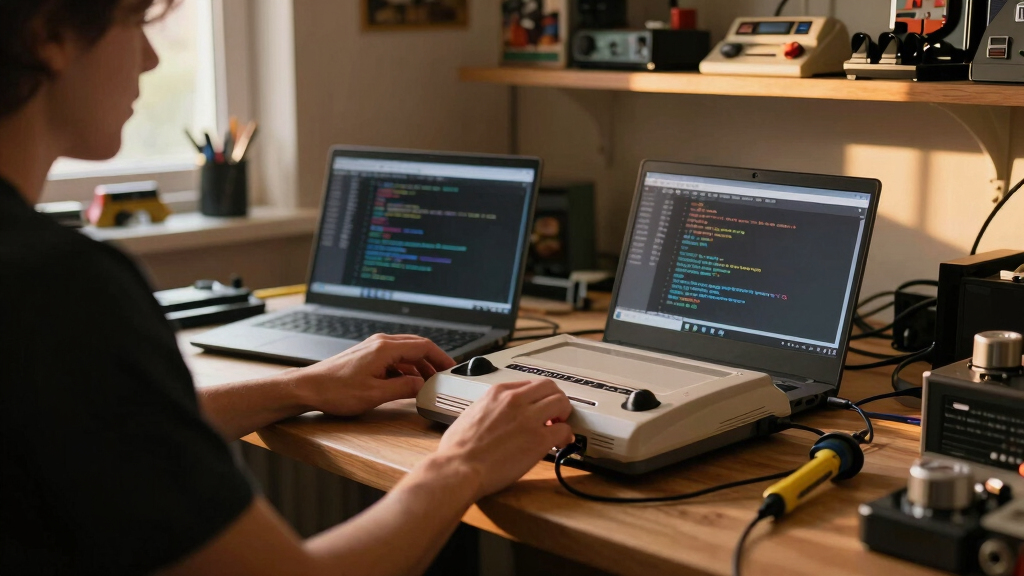
While the project is still in early stages, the developer demonstrated a bootable Linux kernel running on a modified 32X hardware setup, with basic functionality such as command-line interface and file system access. The developer emphasized that this approach could be extended to other legacy hardware systems, questioning the necessity of traditional hardware primitives for modern OS functionality.
Implications for Hardware-Dependent Operating Systems
This development suggests that complex operating systems like Linux may not always require dedicated hardware synchronization primitives, especially in constrained environments. It could influence how future embedded systems and legacy hardware are approached for OS compatibility, potentially reducing hardware complexity and cost.
For enthusiasts and researchers, this opens new avenues for running modern software on vintage hardware, challenging the notion that certain hardware features are indispensable for OS stability and performance.
As an affiliate, we earn on qualifying purchases.
Limited Hardware Capabilities of the Sega 32X and Past Linux Ports
The Sega 32X was released in 1994 as an add-on to enhance the Sega Genesis/Mega Drive, offering a 68k CPU, a GPU, and 2MB of RAM. Its hardware was designed primarily for gaming, with no built-in support for complex OS features like hardware synchronization primitives used in modern operating systems.
Previous efforts to port Linux to similar legacy hardware generally relied on hardware primitives to manage concurrency and memory access. The 32X’s limited hardware made such ports challenging or infeasible, leading most developers to use simplified or custom solutions.
The recent port by RetroDev breaks this pattern by demonstrating that Linux can operate without these primitives, at least in a limited form, on hardware with minimal support for such features.
“By rethinking synchronization, we can run Linux on hardware that traditionally wouldn’t support it. Hardware primitives are not always a strict requirement.”
— RetroDev
embedded system synchronization tools
As an affiliate, we earn on qualifying purchases.
As an affiliate, we earn on qualifying purchases.
Limitations and Stability of the Linux Port on 32X
It is not yet clear how stable or complete the Linux port is on the Sega 32X. The current demonstration appears to be in early development, with basic functionality shown but many features untested or missing. The long-term stability and performance under load remain unconfirmed.
Additionally, it is unknown whether this software-based synchronization approach can scale to more complex tasks or multi-user environments on such limited hardware.
Linux porting hardware accessories
As an affiliate, we earn on qualifying purchases.
As an affiliate, we earn on qualifying purchases.
Next Steps for Development and Broader Testing
The developer plans to refine the Linux port, adding more features and stability testing. Community feedback and collaboration are expected to play a role in advancing this project.
Further testing on different hardware configurations and attempts to run more demanding applications are anticipated to evaluate the true potential and limitations of this approach.
As an affiliate, we earn on qualifying purchases.
Key Questions
Why is bypassing hardware synchronization primitives significant?
It challenges the assumption that such primitives are essential for running complex operating systems like Linux, especially on hardware with limited features.
Can Linux run fully on the Sega 32X now?
Currently, only early-stage demonstrations are available. Full functionality, stability, and performance are still under development and unconfirmed.
What does this mean for legacy hardware projects?
This development suggests that software-based solutions can sometimes replace hardware features, potentially simplifying hardware requirements for running modern OSes on old systems.
Could this approach be applied to other vintage hardware?
Possibly, especially where hardware primitives are lacking or limited. However, success depends on the specific hardware and the complexity of the OS features used.
Source: hn
Halloween Picks
halloween
As an affiliate, we earn on qualifying purchases.