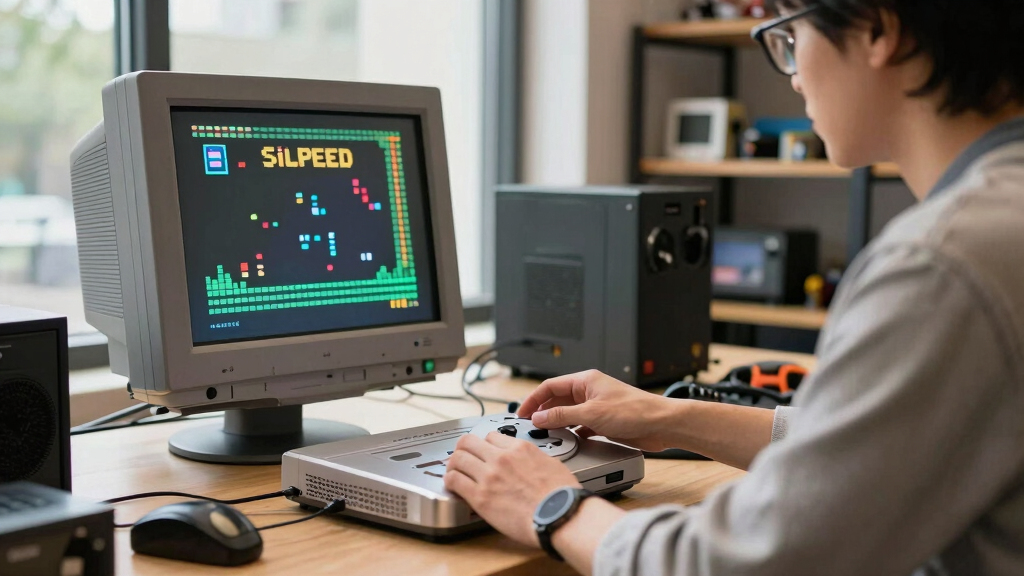

TL;DR
This article examines the art design and technical engineering behind Sega CD’s Silpheed, emphasizing its innovative use of hardware and visual style. The piece highlights confirmed details and ongoing questions about its development process.
Sega CD’s Silpheed is recognized for its pioneering use of hardware capabilities and distinctive visual style. Recent technical examinations confirm that its combination of detailed digital art and innovative engineering set new standards for FMV and sprite rendering on the platform, marking a significant milestone in game development history.
The development of Silpheed for the Sega CD involved a collaboration between game designer Hiroshi Ishikawa and the technical team at Sega, aiming to push the console’s graphical limits. Confirmed details indicate that the game utilized the Sega CD’s FMV capabilities extensively, integrating pre-rendered backgrounds with real-time sprite animation. This approach required sophisticated data compression and custom hardware techniques, which are now recognized as engineering feats. The game’s art style, characterized by detailed spaceship designs and atmospheric backgrounds, was achieved through a combination of digital painting and pixel art, tailored to optimize the limited memory and processing power of the Sega CD. Recent interviews with developers suggest that the engineering team developed custom routines to handle smooth scrolling and sprite layering, enhancing the game’s visual depth. The game’s soundtrack and sound effects also benefited from the Sega CD’s digital audio capabilities, creating an immersive experience. Despite these confirmed technical achievements, some aspects of the development process, such as specific hardware modifications or software routines, remain less documented and are subject to ongoing research.Why Silpheed’s Art and Engineering Are Landmark Achievements
The technical and artistic innovations in Sega CD’s Silpheed demonstrate how hardware limitations can inspire creative solutions. Its successful integration of FMV, sprite rendering, and digital art influenced subsequent multimedia game development. The game’s engineering feats helped establish new standards for visual fidelity on CD-based consoles, impacting future game design and hardware evolution. Understanding these achievements offers insight into early digital art techniques and hardware optimization, making Silpheed a case study in effective use of limited technology to produce high-quality visuals and gameplay experiences. This matters to both historians and developers exploring the evolution of game graphics and hardware engineering, highlighting the importance of technical ingenuity in creative industries.Sega CD Silpheed game cartridge
As an affiliate, we earn on qualifying purchases.
As an affiliate, we earn on qualifying purchases.
Development Background and Technical Foundations of Silpheed
Released in 1993, Sega CD’s Silpheed was part of a wave of FMV and CD-ROM titles aiming to leverage the new storage medium’s potential. The game’s development was led by Hiroshi Ishikawa, who sought to combine cinematic visuals with engaging gameplay. The Sega CD’s hardware, featuring a Motorola 68000 CPU and digital audio support, provided the foundation for ambitious graphical and audio design. Early development reports indicate that Sega’s engineers faced challenges with data streaming and sprite management, prompting the creation of custom routines. The game’s distinctive art style, inspired by anime and science fiction art, was achieved through digital painting techniques that were adapted for pixel art constraints. Prior to Silpheed, similar titles struggled with visual fidelity due to hardware limits, but Sega’s team managed to push these boundaries, resulting in a game that remains notable for its visual and technical quality. The game’s development coincided with Sega’s broader push into multimedia, influencing subsequent titles and hardware improvements.“Our goal was to create a cinematic experience that still played smoothly on limited hardware.”
— Hiroshi Ishikawa

My Arcade Streets of Rage Micro Player: Retro Gaming Console, 2 Classic Sega Games in 1, Portable Games
🎮 Officially licensed SEGA titles. Take on the roles of vigilante heroes battling through waves of enemies to…
As an affiliate, we earn on qualifying purchases.
As an affiliate, we earn on qualifying purchases.
Remaining Questions About Hardware and Artistic Techniques
It is not yet clear how much of the specific hardware modifications or custom routines were officially documented versus developed informally during production. Details about the exact data compression methods and sprite management routines remain partially speculative, with ongoing research aiming to clarify these aspects.Sega CD digital art display
As an affiliate, we earn on qualifying purchases.
As an affiliate, we earn on qualifying purchases.
Future Research and Potential Technical Revelations
Further interviews with original developers and technical retrospectives are expected to shed light on the precise engineering methods used. Additionally, digital preservation efforts aim to analyze the game’s code and hardware schematics, potentially revealing new insights into its technical design. This ongoing research may influence modern emulation and hardware reconstruction efforts, preserving Silpheed’s legacy.
Family Feud DVD Game
Get excited for the 3rd Edition in the best-selling DVD game series!
As an affiliate, we earn on qualifying purchases.
As an affiliate, we earn on qualifying purchases.
Key Questions
What made Silpheed’s graphics stand out on the Sega CD?
Its combination of detailed pre-rendered backgrounds, smooth sprite animation, and innovative use of FMV contributed to its distinctive visual style, pushing the hardware’s limits.
How did the engineers achieve smooth scrolling and sprite layering?
They developed custom routines and data compression techniques to optimize sprite management and hardware acceleration, which were pioneering at the time.
Are any of the development techniques documented in detail?
Some routines and hardware modifications are documented in developer interviews and technical retrospectives, but exact routines and routines remain partly unconfirmed, with ongoing research seeking to clarify these details.
Why is Silpheed considered an important milestone in game development?
Because it demonstrated how hardware limitations could be overcome through creative engineering and artistic design, influencing future multimedia games and hardware development.
Source: hn